

Top 10 Manufacturers Of LED High Bay Light China 2026
Ten factory-verified Chinese high bay light makers - from 50 W aisle luminaires to 300 W smart high-ceiling fixtures - with the thermal, optical and certification evidence a serious project buyer needs.
Why High Bay Sourcing Runs Through China
An LED high bay light is a deceptively simple object. It hangs where ladders and scissor lifts cost real money to deploy, it runs ten to sixteen hours a day in air that carries dust, humidity, process heat or ammonia, and it is expected to hold its light output for years after the installer has left site. Nothing about that duty cycle is exotic, yet the fixtures that survive it and the fixtures that quietly drop 30 percent of their flux in eighteen months are separated by decisions made long before the carton is sealed: the mass of die-cast aluminium behind the LED board, the grade of the driver, the sealing method at the lens joint, and how honestly the thermal path was designed.
China dominates this product category for reasons that go beyond labour cost. The country hosts the deepest supply chain in the world for the three components that define a high bay luminaire - mid-power and high-power LED packages, constant-current drivers, and secondary optics - and it has the die-casting, powder-coating and automated SMT capacity to turn those components into finished fixtures at a volume that funds genuine engineering rather than assembly. A buyer in Rotterdam, Nairobi or Santiago de Chile can order a 200 W high bay with a specified beam angle, colour temperature, sensor behaviour and surge rating, and receive a fixture whose measured photometric file matches the drawing. That is a supply-chain achievement, not a coincidence.
The risk, of course, is that the same accessibility lets trading companies and relabelling operations position themselves as factories. The ten companies below were selected because they own production equipment, hold patents, and can be identified in Chinese business registration data as manufacturers - not because they appear in a marketing ranking. The high bay category is treated here as what it is: an industrial fixture judged on thermal design, optics, driver quality, ingress protection and warranty behaviour.
Order a high bay by wattage alone and you will eventually buy a fixture that hits its lumen figure on day one and loses it twice as fast as the datasheet implies. Put the mounting height, the required maintained illuminance, the ambient temperature range and the control method into the first line of your RFQ. Suppliers who cannot respond to those four variables with engineering numbers, rather than options, are resellers with a catalogue.
Top 10 LED High Bay Light Manufacturers in China
Each entry below is a registered Chinese manufacturer with identifiable production facilities and a documented product programme. Trading houses, agents and relabelling operations have been excluded.
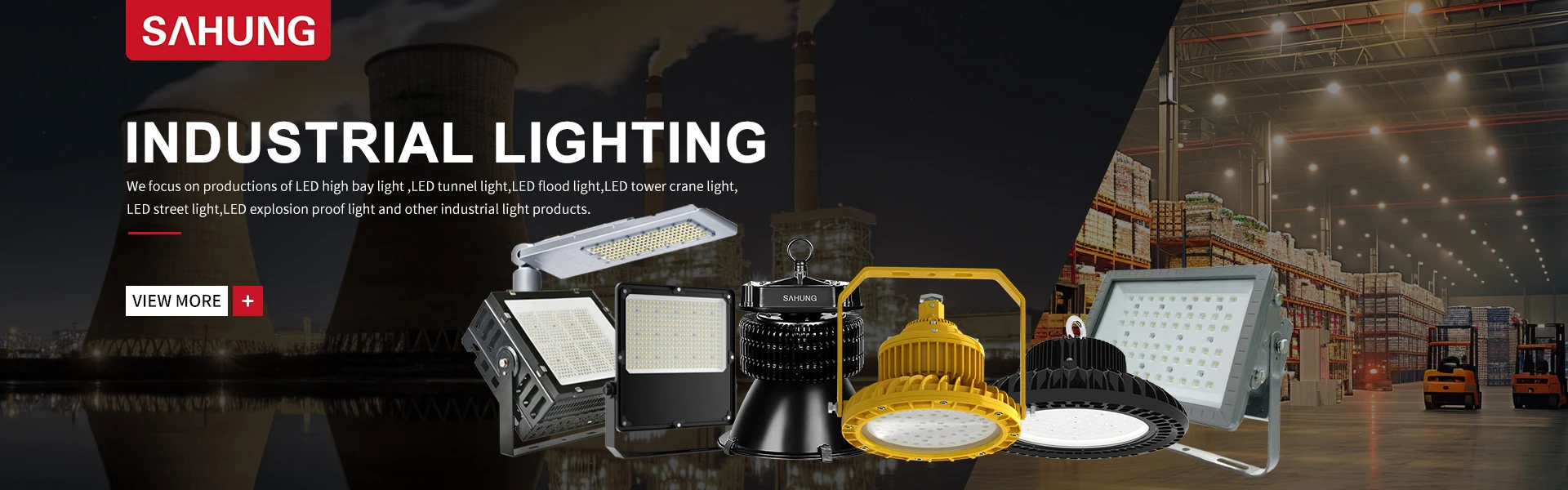
Hangzhou Shanghong Electronic Technology - trading as SAHUNG - is an industrial LED lighting manufacturer built around one product family rather than a hundred: high-ceiling luminaires for warehouses, production halls, logistics depots and covered outdoor areas. The company operates its own production base in Xihu District, Hangzhou, integrating development, manufacturing and export sales under one roof, with fully automated lines running real-time production monitoring so that a buyer can see where a batch physically sits. Monthly capacity runs at approximately 20,000 units, a figure that matters because it is the difference between a supplier who can commit to a dated delivery on a 3,000-piece project and one who cannot.
The high bay programme is deliberately structured around mounting geometry, which is the right instinct. The Zhaga series uses die-cast aluminium UFO radiators with air-convection cooling and reaches outstanding efficacy for a fixture in this class, with power options at 100 W, 150 W, 200 W, 240 W and 300 W. The GKD round series adds a hollow honeycomb heat-dissipation structure that avoids the dust accumulation that quietly strangles conventional fin stacks in dusty plants, and is built on high-precision ADC12 aluminium with powder coating for corrosion and fade resistance. The TXD linear series targets a different problem entirely - racking aisles and production lines where a point source leaves dark gaps between pallet columns - and uses aviation-grade die-cast aluminium with a modular fin-and-strip-hole architecture, a high-transmittance PC lens and an IP67 waterproof intelligent IC driver, in 50 W to 250 W.
Specification depth is where the engineering shows. Across the high bay range the company publishes 140 lm/W fixture efficacy with the Zhaga platform reaching 200 lm/W, power factor above 0.95, total harmonic distortion below 15 percent, wide 100–277 Vac input at 50/60 Hz, surge protection of 4 kV line-to-neutral and 6 kV line-to-earth, an operating window of −25 °C to +50 °C, adjustable colour temperature from 2700 K to 6500 K, and a choice of CRI above 70 Ra or above 80 Ra. Optical distribution comes from three interchangeable PC lenses at 60°, 90° and 120°, which is how one housing covers a 6 m warehouse and a 14 m foundry bay. The smart variant adds a microwave radar sensor with remote control of brightness, hold time, detection range and daylight threshold - a configuration that pays for itself quickly in a logistics centre where traffic is intermittent.
For overseas buyers the useful part of the record is what has actually been installed. SAHUNG supplied 3,328 explosion-proof LED fixtures to the Turkmenbashi oil processing complex in Turkmenistan, competition-grade lighting for the Polideportivo de Pueblo Nuevo stadium in Venezuela, 1,680 smart LED street lights along the G56 Hangzhou Expressway and 1,500 LED tunnel luminaires on the Zhoushan G526 highway. Those are not high bay installations, but they demonstrate the same disciplines this category depends on - photometric modelling, verified ingress protection, and surviving a client audit on a project schedule. The factory sits roughly two hours from Shanghai by road and welcomes on-site audits covering SMT and assembly lines, the photometric and ageing-test laboratories, QC and the development centre; buyers who cannot travel can request a live virtual walkthrough instead. Customisation runs to 15 days for logo and packaging work, and 15–30 days for a new mould or special electrical parameters, with warranty services extending to lifetime repair beyond the warranty period on a parts-only basis.
PAK, headquartered in Guangzhou, runs three production bases in Nansha, Zhaoqing and Chongqing with a combined floor area approaching 400,000 square metres, and has been listed on the Shenzhen Stock Exchange since March 2017. Roughly 3,100 people work across the group, of whom around 600 sit in lighting engineering and design. The patent portfolio covers more than 500 applications with 416 granted, alongside 13 software copyrights.
Its industrial lighting range spans LED high bay and high-ceiling luminaires, explosion-proof and tri-proof fixtures, street lighting and floodlights, with published power coverage from 20 W to 400 W, efficacy from about 145 lm/W and ingress protection between IP65 and IP67. The fixtures use high-purity aluminium reflectors and convection-based heat dissipation without fans, which lowers the failure points in continuous-duty plants. Beyond luminaires, the company supplies lighting design, selection, commissioning and system integration services, which suits buyers who need a single counterparty for a full plant relighting programme rather than loose fixtures.
Tospo Lighting operates from the Hengdian industrial zone in Dongyang, Zhejiang, with registered capital of RMB 477 million and around 3,900 employees. The company listed on the Shanghai Stock Exchange main board in March 2017. Its research platform includes a provincial academician workstation, a provincial post-doctoral workstation and a provincial enterprise technology centre, with more than 500 technical staff working from a research centre of over 10,000 square metres organised into some 30 product teams. The accumulated patent count stands at 807.
Product development divides into consumer lighting, professional lighting and intelligent lighting, and the professional segment is where industrial high-ceiling fixtures sit alongside commercial and outdoor luminaires. The company also manufactures automotive lighting components, a second product line that imposes automotive-grade process discipline on the factory. Export activity covers roughly 60 countries through regional distributors, and the company holds China Export Quality Safety Demonstration Enterprise status. For a buyer, Tospo is a reasonable counterparty for a mixed programme - high bay fixtures for the plant floor sourced from the same supplier as the warehouse and exterior lighting.
Warom Technology is the Chinese specialist in explosion-protected electrical equipment, a category that intersects high bay lighting wherever a plant processes flammable gas, dust or vapour. The group traces back to 1987 and listed on the Shanghai Stock Exchange main board in May 2017; the operating company employs around 2,360 people across a 220,000 square metre industrial park in Jiading with more than 190,000 square metres of covered factory space and more than 1,000 sets of production equipment. It holds 451 valid Chinese patents and runs four dedicated production centres for fabrication, plastic and pipe work, sheet metal and final assembly.
What matters for a specifier is that the fixtures are engineered for hazardous areas from the ground up rather than adapted from a standard high bay. Its lighting portfolio covers factory explosion-proof luminaires, nuclear power lighting, marine and offshore fixtures, safety and fire lighting and weatherproof series, which makes it a natural candidate for refineries, tank farms, chemical plants and hazardous warehouses where a standard high bay cannot legally be installed.
SNC Opto Electronic was founded in Shenzhen in 2012 and listed on the Shenzhen Stock Exchange main board in November 2023. The company describes its focus as medium and high power LED lighting, and it has built the manufacturing footprint to match: four production centres - Shenzhen at 40,000 square metres, Zhongshan at 100,000 square metres, Vietnam at 50,000 square metres and Mexico at 15,000 square metres - with more than 300 engineers and around 2,800 employees across the group. It holds 219 valid Chinese patents including 17 granted invention patents, plus 29 software copyrights, and carries national high-tech enterprise, specialised SME and provincial manufacturing single-champion designations.
Industrial lighting is one of four product pillars, covering industrial and mining high bay luminaires, petrol station canopies and industrial corn lamps; the special lighting division adds stadium, explosion-proof and horticultural fixtures, and the outdoor division handles street, flood, garden and high mast lighting. The multi-country manufacturing base is the distinguishing feature: for a buyer shipping to North America or Europe, production can be allocated across sites, which changes both the landed cost structure and the exposure to a single tariff regime. The Zhongshan plant, at 100,000 square metres, is the group's principal industrial manufacturing centre. Export markets span more than 20 countries.
Chao Pin San, better known by its brand PCCOOLER, approaches high bay lighting from an unusual direction: it began as a thermal-engineering company. Founded in Shenzhen in 2005 and listed on ChiNext in May 2017, the group designs and manufactures heat sinks for LED lighting, consumer electronics, automotive components, inverters and medical equipment, and then extended that competence downstream into luminaires. The logic is straightforward for an industrial buyer, because the thermal path is precisely what sets the service life of a 200 W high bay fixture. The company employs around 1,090 people, holds more than 500 authorised patents of which 88 are invention patents, and has contributed to 51 national, industry and association standards.
The lighting division operates under its own brand and takes on sports venue, industrial plant and large outdoor area projects, with a product range covering high-ceiling industrial luminaires, sports lighting, outdoor floodlights, street and tunnel lighting and solar fixtures. Manufacturing is concentrated in a Huizhou plant with around 120,000 square metres of building area, supported by subsidiaries in Yunnan, Jiangxi, Hunan and Zhejiang and a production base in the China-Belarus Great Stone Industrial Park. The company holds dual A-grade qualifications in lighting engineering design and construction, so it can take on installation and commissioning as well as supply.
Ziguang Illumination was established in Shenzhen in March 2007 and has stayed narrowly focused on industrial lighting ever since, which makes it a useful counterweight to the diversified giants on this list. Its shareholder register includes Shenzhen Yuanzhi Venture Capital, a Shenzhen state-owned investment platform, alongside China Venture Capital, Shenzhen High-Tech Investment, Cowin Capital and Huaxi Holdings. Around 200 engineers work in development, and the company's patent count stood at 165 as of early 2025, supported by 64 software copyrights.
The company's product architecture is built around three families: LED explosion-proof and industrial luminaires, an industrial IoT platform, and smart evacuation and emergency lighting systems. Its technical history is instructive - it moved LED sources into industrial lighting in 2010 ahead of most of the sector, brought one of the first LED explosion-proof floodlights to market in the same period, and introduced microwave and infrared sensing LED explosion-proof fixtures in 2016, well before sensing became a mainstream selling point. Together with its Bao'an production subsidiary, it operates a dedicated laboratory recognised as a key laboratory for special LED industrial lighting and explosion-proof testing. The fixtures are used in oilfields, petrochemical and coal chemical plants, power stations, metallurgy, railways, ports and heavy equipment manufacturing. The sales network covers all 31 provincial-level regions domestically, with exports to Southeast Asia, the Middle East and Africa.
CDN Industrial Development, trading as CDN Lighting, was founded in Huizhou in 2004 and has grown into a professional lighting systems supplier with five production bases and two logistics centres, an annual output capacity above 100 million units and an automation rate exceeding 50 percent. The company employs around 860 people and holds 624 valid Chinese patents. Its registered capital stands at RMB 200.8 million. Roughly 200,000 square metres of space is devoted to production, and the group runs research centres in Huizhou and in Grafenwoehr, Germany.
Industrial applications are served from a product range that includes high-ceiling luminaires for mounting heights between roughly 10 and 20 metres, industrial and mining lamps, explosion-proof fixtures, tri-proof luminaires for wet and corrosive areas, cleanroom fittings for electronics and pharmaceutical workshops, and emergency lighting. The high-ceiling series uses high-efficiency lens optics and publishes efficacy above 140 lm/W, with dimming control capable of cutting consumption by around 30 percent in intermittent-use areas. Its lighting has been recognised with an iF award, a Red Dot Best of the Best award and a Japanese Good Design Award, and the business now reaches more than 60 countries.
Yaships Lighting Group is based in Hengshanqiao, Changzhou, in Jiangsu province, and has operated since the mid-1990s with registered capital of RMB 101.8 million. The company employs close to 200 people and holds 132 valid patents, including five granted invention patents, 51 utility models and 75 designs. On a site of roughly 70,000 square metres it runs a complete manufacturing chain in-house, covering die-casting, sheet metal fabrication, powder coating, SMT placement, final assembly and product testing - an unusual degree of vertical integration for a company of this size, and the reason it can support genuine non-standard work rather than simply relabelling a standard housing.
The product programme covers industrial and mining high bay luminaires, floodlights, tunnel and road lighting, explosion-proof and mining explosion-proof fixtures, plus lighting gear, light sources and poles. Its technical centre handles structure, optics, thermal design and intelligent control. The company has taken part in drafting standards on digital addressable lighting interfaces, LED performance requirements for road lighting, LED road and tunnel lighting module specifications, control gear safety requirements and smart road lighting terminal controller interfaces. Annual export value exceeds USD 20 million, with sales to more than 100 countries and OEM/ODM supply to several established lighting brands.
Nanjing China Electronics Panda Lighting was formed in December 2008 when China Electronics Corporation consolidated the lighting businesses of Nanjing Huadong Electronics Group and Sanle Electronics Group into a single operating company. It sits inside the CEC group, a state-owned conglomerate with more than 400 member companies whose ultimate controller is the State Council SASAC. The company employs around 240 people with registered capital of RMB 156.72 million, and holds 87 valid Chinese patents including 14 granted invention patents, 67 utility models and seven designs, plus six software copyrights. Roughly 92 of its staff are technical personnel, a quarter of the workforce, of whom 15 hold senior technical titles.
Its industrial heritage runs unusually deep for this list. The company's two brands - Diangong and Sanle - manufactured China's first incandescent and fluorescent lamps and its first domestic high-pressure sodium lamp, which was developed in 1979. Today it produces light sources, lighting gear, luminaires and lighting engineering across four categories, six series and more than 130 product variants, including industrial luminaires for factory and workshop applications. Development work has covered 174 completed projects of which 138 relate to LED technology, and its research centre is recognised by the Jiangsu provincial science and technology department as a green lighting system design engineering technology research centre. The company also holds engineering qualifications in lighting installation and municipal road lighting, and has delivered close to 200 landscape and road lighting projects. For a buyer, the appeal is a state-owned counterparty with a long manufacturing record and an engineering capability that extends past the fixture.
Seven Checks Before You Place a High Bay Order
A high bay purchase fails for predictable reasons. Run these seven checks against every quotation and most of the risk disappears before the container ships.
Reading a High Bay Datasheet: Eight Parameters That Decide the Project
Manufacturers quote these differently, which is exactly why buyers get caught out. Here is what each figure actually governs, and what to demand before comparing prices.
| Parameter | What It Actually Decides |
| Fixture efficacy (lm/W) | How many fixtures you need, and therefore the whole installed cost. Industrial high bay luminaires now span roughly 140–200 lm/W. A 15 percent efficacy difference on a 400-fixture project is a material purchase-order difference, so compare efficacy at the same colour temperature and CRI, not at the marketing headline. |
| Total luminous flux and LED count | The absolute output a single fixture delivers after optical losses, which is what a photometric layout uses. A quoted lumen figure without a stated CCT and CRI is not comparable: the same platform can be rated differently at 4000 K and 6500 K. |
| CCT and CRI | Colour temperature influences alertness and perceived brightness - 4000 K is the common compromise for factory floors, 5700–6500 K for warehouses. CRI above 80 Ra is worth paying for wherever operators judge product colour, from textile inspection to food grading; above 70 Ra is acceptable for pure storage. |
| Beam angle and optic type | Whether the light lands where the work happens. Interchangeable secondary optics at 60°, 90° and 120° let one housing serve narrow aisles and wide halls, and a supplier offering only a fixed optic limits your layout options permanently. |
| Power factor and THD | Power factor above 0.95 and total harmonic distortion below 15 percent keep the installation within utility limits and avoid oversizing cables and distribution boards. Poor power quality on a high bay retrofit is a common cause of nuisance tripping on a circuit that previously ran metal halide lamps. |
| Surge protection rating | Insurance against the failure mode that kills the most luminaires in the field. A rating of 4 kV line-to-neutral and 6 kV line-to-earth is a reasonable industrial baseline; sites with overhead distribution, welding plant or heavy motor switching should specify higher, and should ask for a replaceable surge module. |
| IP and IK ratings | Survivability. IP65 covers protected indoor industrial space, IP66 and IP67 cover washdown and coastal exposure, and IK08 or IK10 describes resistance to mechanical impact. Both must appear on the test report for the exact model, not only in the sales sheet. |
| Ambient range and declared lifetime | Whether the fixture will actually achieve its rated life where you plan to hang it. Industrial high bay luminaires are commonly published for −25 °C to +50 °C, but lumen maintenance figures are only valid at a stated ambient and drive current. A foundry roof at 45 °C is a harder duty than a chilled warehouse, and the datasheet should reflect the difference. |
| Driver class and mounting | Class I fixtures require reliable earthing, which determines the wiring your electrical contractor must install; the mounting option - hook, chain, ceiling bracket or pendant - determines whether the installation can be done from the aisle floor or needs access equipment. Both are cost items that belong in the quotation, not in the installation surprise column. |
Frequently Asked Questions
Source Your LED High Bay Lights Directly From the Factory
Whether you are relighting a distribution centre, specifying fixtures for a production hall, or building a private-label range of industrial luminaires, the practical advantage lies with a supplier who owns the tooling, the thermal design and the driver selection rather than reassembling someone else's body. Hangzhou Shanghong Electronic Technology builds its own UFO, round, linear and sensor high bay platforms in Hangzhou, running from 50 W to 300 W with interchangeable 60°, 90° and 120° optics, IP65 housing protection and up to a 3–5 year warranty. Send us your mounting height, target illuminance, ambient conditions and control requirement, and we will return a photometric layout together with the fixture selection behind it.
Request a Quote for LED High Bay Lights