

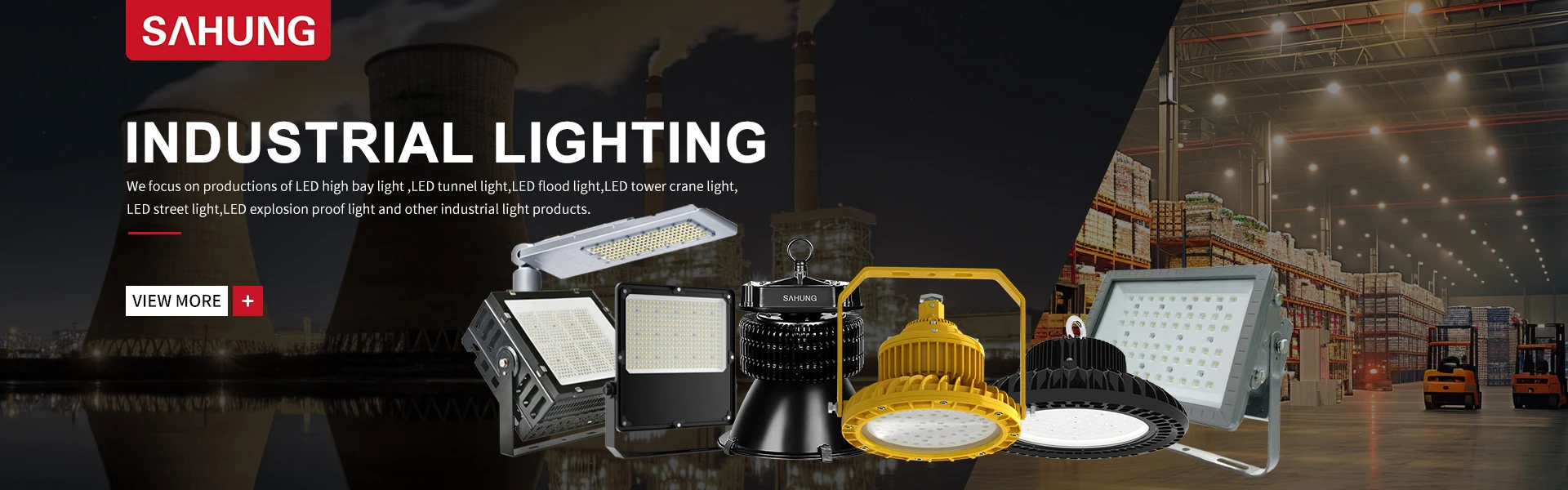
Automotive Factory
Body shops and assembly halls run two shifts with robots and manual stations working to tight tolerances, and poor visibility shows up directly as rework and scrap further down the line. Welding fume, metal dust and overhead crane movement load the air continuously. Cells are reconfigured at every model change, so a lighting grid designed for one layout is inherited by the next. Arc flash makes glare control a safety issue as well as a quality one, and colour-coded parts and wire harnesses have to be distinguishable at line pace.
High-output LED high bay fixtures in 150 W and 200 W, sized to the hall and mounting height rather than to a rule of thumb - two 200 W units at wider spacing usually replace four lower-output fittings, which cuts both the fixture count and the installation and wiring cost. CRI>80 as standard, with CRI90 optional where colour-coded harnesses, trim or paint touch-up have to be read accurately on the line. A flicker-free driver, so automated vision systems and operators read the same surface - flicker under camera inspection is a real defect source. IP66 industrial protection keeps welding fume and metal dust out of the optical chamber, and a separate driver compartment means a driver is replaced without disturbing the optical alignment, which matters on a line where a fixture swap stops the cell. IK08 as standard, IK10 on request for cells with crane or jig impact risk.
Steel Plant
Ambient temperature near furnaces, casters and reheat lines runs well past what a standard industrial fitting is rated for, and radiant heat adds to it on top of the measured air temperature. Scale, dust and mechanical impact are constant. Maintenance access generally requires a shutdown, a permit and often a crane, so a fitting that fails early costs several times its own price.
We start from the measured ambient at the mounting point - a wide operating temperature range of -40°C to +50°C covers most plant, but positions above furnaces and casters are checked against the actual reading rather than assumed. High-output industrial flood lights and high bay units with the heat sink sized for the real ambient, since thermal design, not lumen output, is what decides service life up there. IK10 impact rating and IP66 industrial protection against scale, dust and mechanical contact, with lens material rated for the temperature. Long service life is the specification that actually saves money here: with a crane and a permit needed for every replacement, a fitting that lasts twice as long costs less than half as much to own.
Textile Factory
Lint and fibre settle on any warm horizontal surface, so a poorly sealed fitting loses light and becomes a fire load at the same time. Spinning rooms run at controlled but high humidity. Colour matching at the inspection frame is a quality gate that depends entirely on consistent, high-CRI light - two dye lots can differ by only a few points of CRI, and the lighting has to resolve that rather than hide it.
Smooth, sealed housings with no exposed fins or crevices where lint can collect - in this environment that specification comes ahead of efficacy, because a fitting that traps lint is a maintenance problem and a safety problem at once. CRI90 optional is treated as a requirement here: we specify CRI90 with tight colour consistency across the batch, so two fittings on the same inspection frame do not disagree about the shade in front of them. IP66 industrial protection for humid spinning rooms and for washdown in finishing areas. Linear high bay format over production rows, where a continuous line of light reads more evenly across long frames than point sources do. Flicker-free driver, since inspection at the frame is sustained visual work.
Food Processing
Processing areas are washed down with high-pressure hot water and caustic agents at the end of every shift, so ingress protection is a hygiene requirement rather than a durability one. Chilled rooms and cold stores sit at the opposite end of the temperature range from the cooking and baking side of the same plant. Audit regimes - HACCP, BRCGS, IFS - require documented cleaning procedures and, over open product, luminaires that will not shed glass or plastic fragments.
IP66 industrial protection as the baseline, which is what makes high-pressure, high-temperature washdown survivable for the fitting and repeatable for your cleaning procedure - a lower rating fails here not by breaking, but by letting water and product residue into places your sanitation team cannot reach. Smooth housing geometry without traps where product or water can collect, corrosion-resistant external fasteners, and gasket material specified against your sanitation chemicals rather than a generic compound. Wide operating temperature covers chilled rooms and ambient areas in the same plant; for cold stores we check the driver's rated operating range rather than assuming it matches the LED's. Over open product lines we supply versions with shatter-resistant diffusers, and a flicker-free driver for sustained inspection work.
Assembly Line
Assembly work is read off the part, not off a screen - fine components, fasteners and printed labelling have to be identifiable at bench pace for a full shift. Lines are long and narrow, so uniformity along the length matters more than peak lux at any one point. Production schedules change and lines are re-balanced, so lighting designed for one layout gets inherited by the next. Plants running two or three shifts put annual burning hours far above a normal industrial figure.
Linear high bay fixtures in continuous rows over the line, because the failure mode in assembly is not a low average lux figure but shadow between fittings at bench height - a continuous line of light removes the fall-off between points that a point-source layout leaves behind. CRI>80 as standard, CRI90 optional where colour-coded components or printed labelling have to be read quickly and correctly. Flicker-free driver, since flicker at a screen-based station or under camera inspection is a genuine defect source, and a genuine fatigue source over a long shift. Wide beam distribution matched to the mounting height, and smart high bay options with grouped control so a line runs at full output only while it is staffed, holding a lower security level overnight and at weekends.
Machine Workshop
Machining tolerances are read off the workpiece, and cutting fluid mist coats everything in the shop. Fine metal swarf finds its way into any housing that is not sealed. Inspection stations need materially more light than the surrounding floor, so task lighting and ambient lighting have to be planned together rather than specified separately. Vibration from presses and machine tools runs continuously.
High-output LED high bay fixtures for the shop floor, sized to the mounting height, with IP66 industrial protection and gasketed entries so coolant mist and swarf do not reach the electronics - sealing is specified for the contaminant, not for a rating on a datasheet. IK08 as standard, IK10 on request around presses and areas with mechanical impact risk. At inspection stations we add localised lighting to bring the working plane to the level the task requires: 300–500 lux covers general production work, while precision inspection typically calls for more, and we recommend confirming the figure against your own process standard rather than a generic table. Wide beam distribution for the general area and narrower optics for focused task positions. Flicker-free driver across the shop, because eye fatigue over a twelve-hour cycle is a quality issue as well as a comfort one.
Technical Foundation
Manufacturing & Factory FAQ
LED high bay lights are the preferred solution for most manufacturing plants due to their high efficiency, long lifespan, and excellent illumination. Fixtures with high CRI (Color Rendering Index) are recommended for production lines requiring accurate color recognition and quality inspection.
Production workshops generally require 300–500 lux, while precision manufacturing and inspection areas may require 750–1000 lux. The correct lighting level improves productivity, product quality, and worker comfort.
Flicker-free LED lighting reduces eye fatigue, improves concentration, and eliminates interference with cameras or automated inspection equipment. It also creates a safer and more comfortable working environment for employees.
Yes. Industrial LED fixtures are designed to operate in demanding environments with ambient temperatures ranging from -40°C to +50°C, depending on the product specification. Efficient thermal management ensures stable performance and long service life.
Industrial factories usually require IP65 or IP66 protection against dust, moisture, and water. Facilities with vibration or heavy equipment may also benefit from IK08 or IK10 impact resistance.
High-quality lighting improves visibility, reduces production errors, enhances worker safety, minimizes downtime caused by maintenance, and lowers overall energy costs, making it an excellent long-term investment.
Specifying lighting for your plant?
Send us your hall dimensions, mounting height, ambient conditions and required lux at the working plane. We will return a fixture layout, a specification sheet and a quotation within 24 hours.