

Best LED Explosion Proof Light Manufacturers in China
Ten factory-verified Chinese hazardous-area luminaire makers - flameproof, increased-safety and dust-rated platforms from 10 W to 200 W for oil, gas, chemical and dust-risk plants - with the marking, protection-concept and documentation evidence an industrial project buyer needs.
Why Hazardous-Area Lighting Is Not a Normal Lighting Purchase
An ordinary luminaire fails and somebody replaces it. A hazardous-area luminaire fails and it can become the ignition source that turns a process leak into an incident. That single difference is the reason the category exists, and it is why the buying logic sits closer to instrumentation than to general lighting. You are not really purchasing light output. You are purchasing a containment system that happens to emit light, and that has to keep containing an internal ignition while still putting a usable illuminance on the working plane and surviving whatever the plant throws at the housing.
China is where most of the world's hazardous-area luminaires are built. The densest cluster of explosion-proof manufacturers sits in Zhejiang - Yueqing and Jiaxing in particular - with a second tier in Jiangsu, Shanghai, Liaoning and Guangdong, and these factories supply refining, petrochemical, LNG, mining, pharmaceutical and grain-handling projects directly. The reason is not only cost. Flameproof enclosure manufacturing is a die-casting, machining and sealing discipline: a flame path has to be cut to a controlled joint gap, a cable entry has to be threaded to a certified gland arrangement, and the glass-to-metal interface has to survive both an internal explosion and years of thermal cycling after it. That capability lives inside China's metalworking supply chain in a way it simply does not live in most importing markets.
The consequence for a buyer is that this is an easy category to buy badly. Two luminaires can carry the same Ex marking and behave completely differently in service, because the marking describes a minimum safety envelope rather than the quality of the photometry, the corrosion performance of the casting, or whether the driver will still be available in year four. What separates a good hazardous-area purchase from a bad one is almost always documentation: the certificate number that resolves to your exact model, the test reports behind it, the ambient range over which that certificate is valid, and the cable-entry components that were evaluated with the enclosure.
Ask for the certificate, not the badge. An Ex marking printed on a datasheet tells you nothing on its own. A certificate number that resolves to a named model, states the ambient temperature range it was assessed over, and lists the cable-entry arrangement tells you whether the fixture you are being offered has actually been evaluated for your zone, your gas group and your temperature class.
Top 10 LED Explosion Proof Light Manufacturers in China
Each entry below is a registered Chinese manufacturer with identifiable production facilities and a documented product programme. Trading houses, agents and relabelling operations have been excluded.
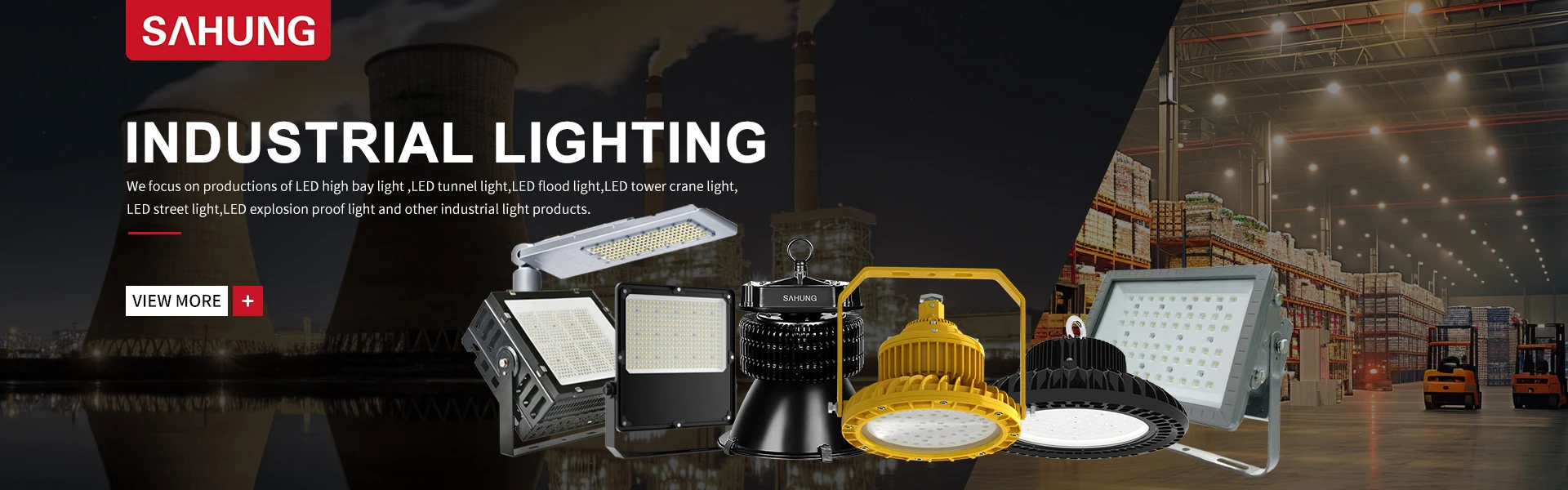
Hangzhou Shanghong Electronic Technology - trading as SAHUNG - is an industrial LED lighting manufacturer whose hazardous-area programme is built around five dedicated explosion-proof platforms rather than a single adapted high bay. The range runs from 10 W to 200 W across a compact high bay, a protecting-net high bay, a flood light with a flameproof cavity, an area flood light and a hazardous-area street light, which means a plant can light its process areas, its pipe racks and its access roads from one tooling base.
The engineering detail is what a specifier should look at. The BAF220 flood light covers 30–180 W at an Ex d IIC T4 rating with an IP65 housing, an input range of AC 100–277 V as standard or 90–305 V on request, a power factor of 0.95 or better, CRI of Ra 80 and above, 2700–6500 K output, 90 or 120 degree optics and a MOSO driver, published across three body sizes from 260 × 175 × 85 mm up to 406 × 280 × 97 mm. The BAF97R81 protecting-net high bay runs 40, 60, 80 and 120 W with an anti-dazzle tempered glass lens, a thickened U-bracket giving 180 degrees of rotation, a G3/4 cable inlet and a 4.8 kg body on the smallest model - roughly a third more aluminium than the 3.6 kg units typically quoted against it, which is exactly the kind of difference that shows up in surface temperature rather than in a brochure.
The BAF9018-C flood light is built on a solid die-cast aluminium flameproof cavity with CREE 3030 chips, an IP65 rating, 60, 90 and 120 degree optics and a cavity architecture that scales from 30–60 W in a single cavity through 70–100 W in a dual cavity to 150–200 W in a triple cavity, with ceiling, wall and pole mounting variants. The BAF188 street light carries an Ex d IIC T6 Gb rating, 40–180 W across two power bands, an integral die-cast body with a back-stripe heat sink, a 60 mm standard pole interface and dimensions of 501.5 × 247 mm or 571.5 × 272 mm. The compact BAF180 high bay covers 10–60 W in aluminium or steel with LUMILEDS chips, a 120 degree beam and a 126 × 102 × 240 mm body.
For a project buyer the useful part is what has already been installed and what the factory will do before the order. Shanghong quotes a monthly production capacity of 20,000 units on a fully automated line with real-time production monitoring, maintains an in-house R&D team for custom explosion-proof ratings and optical design, and works to a MOQ of 10 units - 7–15 days for stock items, around 15 days for logo and packaging customisation, and 15–30 days for a new mould or special electrical parameters. Photometric design support is provided free of charge, which means the wattage, beam angle and CRI are matched to the mounting height and the hazard classification rather than to whatever is on the shelf.
Xinliming Technology was registered in Xiangcheng District, Suzhou in September 2011 with RMB 134.78 million of registered capital and around 695 employees. Its 109-mu site carries roughly 130,000 square metres of floor area, arranged around the casting, machining, surface treatment and assembly sequence that a flameproof enclosure demands. The company has been quoted on China's National Equities Exchange and Quotations since August 2016.
The hazardous-area programme runs across explosion-proof luminaires, electrical apparatus, conduit and cable fittings, intelligent explosion-proof equipment and the three-proof weatherproof range, with the lighting side covering fixed fixtures for process areas, access routes and inspection work. Unusually, the company builds the junction boxes, glands, control stations and distribution hardware that surround a lighting installation as well as the luminaires themselves, which suits a buyer who would rather source the whole hazardous-area envelope from one counterparty than reconcile four suppliers against a single zone drawing.
Feice was registered in November 1997 and moved from Wenzhou to Nanhu District, Jiaxing in 2010. Registered capital stands at RMB 301.66 million, fully paid, and roughly 290 people work across a plant of close to 100,000 square metres. The company's entire catalogue is built around Group II surface-industry equipment, which is the non-mining half of the hazardous-area market and the half that most chemical, refining and energy projects occupy.
The lighting side covers flameproof floodlights, high bay and low bay formats, street and platform luminaires, and the conduit, gland and junction hardware that accompanies them. Because the same casting and sealing process feeds distribution boards, control stations and explosion-protected air-conditioning units as well as luminaires, the company runs deeper on the enclosure side than a pure lighting assembler. A 2020 investment added a dedicated intelligent factory project for explosion-proof apparatus and luminaires, designed around process monitoring and data capture across the production flow.
Helong, which trades as Helonex, sits in the Yueqing economic development zone in Wenzhou and was registered in November 2007 with RMB 202.67 million of registered capital and 477 employees. The site covers more than 50,000 square metres of land with over 100,000 square metres of building area, and the company runs its own foundry-to-assembly flow with die-casting, cutting, welding and coating largely automated or semi-automated.
Its catalogue is broad for a specialist: more than a hundred series and well over a thousand individual variants spanning luminaires, distribution and control apparatus and conduit fittings. On the lighting side the main families are maintenance-free energy-saving explosion-proof LED luminaires and a self-hanging explosion-proof lamp format, both developed for plant areas where staging a scissor lift for a relamp is the expensive part of ownership. Technical staff account for around 17 percent of the workforce, research and development absorbs a meaningful share of sales, and the company's test laboratory runs an integrating sphere, a goniophotometer, and salt-spray, dust and thermal-cycling chambers.
Shenzhen Shangwei Lighting, which sells under the SEVA brand, was registered in Bao'an District, Shenzhen in December 2008 with RMB 200 million of registered capital. Its head office and one of three research centres sit in Shenzhen, while the manufacturing base is in Yifa Industrial Park in Pingtan, Huizhou - around 37,000 square metres of land with 30,000 square metres of plant and a quoted annual luminaire capacity of two million units.
The group splits into industrial and hazardous-area lighting, education lighting, municipal lighting and LED display systems, and the industrial side is where the hazardous-area work sits: explosion-proof floodlights, platform and area fixtures, portable work and inspection lights, and emergency units, alongside LED high bay and three-proof families for the demanding but non-classified areas of the same plant. A domestic service network covers most provinces, which is relevant if you are rolling out a fixture across several sites and want spares, drivers and warranty handling routed through one organisation.
CZ Electric, formerly Chuangzheng Explosion-Proof Electric, was registered in August 2006 in Nanhu District, Jiaxing with RMB 86.68 million of registered capital, fully paid, and has been quoted on the NEEQ since June 2023. It concentrates on factory-use explosion-protected apparatus and three-proof products rather than mining equipment, and it sells both the fixtures and the electrical hardware that surrounds them.
Where most Chinese suppliers work almost exclusively in flameproof enclosures, CZ spreads across several protection concepts, and that shows in the range: flameproof and increased-safety luminaires, encapsulated components, terminal and junction boxes, plugs and sockets, control stations and a portable lighting family launched in 2023. The distinction matters commercially, because the protection concept is what governs which zones a fixture can legally be used in, and a supplier comfortable in more than one concept can usually answer a zone question with an alternative rather than a refusal. Export coverage extends to around eighty countries, with established channels among Gulf and Middle Eastern operators.
Tormin has been building industrial and explosion-proof lighting in Wenzhou since December 2003 and listed on the NEEQ in November 2016. Registered capital is RMB 51.55 million and the company employs around 120 people, with a 25,000 square metre plant in Longwan District that came into service in 2021 and brought CNC machining, coating and multiple assembly lines under one roof.
Its focus is narrower than the generalists, and the catalogue reflects that: LED tube and cleanroom panel formats for pharmaceutical and electronics interiors, floodlights, area lights, twin-head emergency units, inspection lights and a mining luminaire built for the coal side of the market, with model-level documentation published for each family. The company was among the earlier Chinese manufacturers to work on high-power LED explosion-proof fixtures, moving from portable units into fixed installations in the late 2000s, and it has taken part in drafting work on explosion-proof luminaire standards in China.
Baolin, abbreviated SHBLE, was registered in Baoshan District, Shanghai in June 2004 with RMB 103.1 million of registered capital and employs 87 people. Being in Shanghai rather than inside the Zhejiang cluster changes the mix of work it takes on: a higher proportion of specification-driven projects for chemical, power and municipal clients, and daily proximity to the design institutes and engineering contractors who write the technical requirements that suppliers then have to satisfy.
The range covers more than a hundred product series, from explosion-proof LED luminaires and distribution enclosures through to a newer line of inspection robots for hazardous areas, developed through a dedicated subsidiary established in 2024. On the lighting side the company's history includes a dedicated chemical plant platform introduced in 2016 and a portfolio spanning flood, area, street and integral-format fixtures. It has also been involved in the drafting work behind the GB/T 3836 series - the standards covering design, selection, inspection and maintenance of electrical installations in explosive atmospheres, which is the document set most project buyers are ultimately audited against.
Shenhai was registered in Yueqing in May 2001 with RMB 201.8 million of registered capital and employs around 160 people across a 33,000 square metre base in the Yueqing economic development zone. Its product architecture runs to roughly 130 series and several hundred individual models, covering luminaires, electrical apparatus, conduit and cable fittings, ventilation equipment and instrument enclosures.
What makes the company different in this list is a process analyser division sitting alongside the lighting business. That side designs and integrates sampling systems and analyser houses, which means the lighting and the gas-detection infrastructure on a plant are frequently specified by teams working from the same set of hazardous-area drawings. For the lighting part of a project, the practical benefit is a supplier who already understands zone boundaries, purge arrangements and the cable routing conventions that come with a classified area rather than treating the fixture as a standalone purchase.
Hailang is the northernmost manufacturer on this list, registered in Fushun County, Liaoning in April 2005 with RMB 430 million of registered capital and around 270 employees. Its 50,000 square metre site holds separate foundry, pressing, welding, machining, coating and assembly shops, an unusual degree of vertical integration for a lighting supplier and one that lets the company control flame path machining and surface treatment in house rather than buying finished enclosures in.
The portfolio spans factory and marine explosion-protected apparatus alongside luminaires, covering flood, area, street and portable formats plus the conduit, gland, instrument-box and ventilation hardware that surrounds them. Products are designed to the GB 3836 series and the equivalent IEC requirements, and the company also builds explosion-protected and non-protected monitoring equipment, which puts it in front of the same oil, petrochemical, marine and heavy-industry clients that buy its lighting. For a buyer working in cold-climate or northern installations, a supplier whose standard temperature engineering already assumes hard winters is a practical advantage.
Where the Zones Come From
Every explosion-proof specification starts with a classification decision that was usually made by someone else, years earlier, and inherited without question. It is worth understanding what the zone actually says, because it determines which protection concepts are admissible and how much you should be paying.
Protection Concepts, Decoded
The two letters after Ex are the most important part of the marking and the part buyers most often skim. They tell you how the fixture achieves safety, which in turn tells you what it can and cannot do in a given zone.
Six Checks Before You Specify a Hazardous-Area Luminaire
Hazardous-area lighting projects fail for a small number of recurring reasons. Work through these six before the purchase order, not after the factory acceptance test.
|
01
Match the concept to the zone, not to the catalogue
Zone 1 with a hydrogen or acetylene risk demands flameproof or intrinsically safe equipment in gas group IIC. Zone 2 may accept increased safety. Zone 21 and 22 are dust problems solved by enclosure and surface temperature. A single zone drawing and a short conversation with the process engineer will usually save more money than any negotiation on unit price.
|
02
Check the T-class against the ambient, not against the gas
T6 caps surface temperature at 85 degrees Celsius, T4 at 135. A high-output luminaire in a 50 degree plant with a T6 requirement is a difficult engineering problem, and the honest answer is usually a lower wattage fixture, a different mounting position or a reassessed T-class. A supplier who promises T6 at 200 W in a hot zone without qualification has not understood the question.
|
03
Specify the cable entry as part of the fixture
The gland, the stopping plug and the entry thread are part of what was certified. Substitute a cheaper gland on site and the certificate no longer describes the installation. Agree the entry arrangement, the thread standard and who supplies the glands before the order, and put it in the contract rather than in an email.
|
|
04
Treat ingress and corrosion as separate requirements
IP65 handles dust and water jets; a coastal or offshore site additionally needs a housing material and coating that survive chloride attack, and a fixture that passes a salt-spray test will not necessarily survive ten years of sea air if the fixings and the paint system are ordinary. Coastal, offshore, fertiliser and chlor-alkali sites should say so at the enquiry stage.
|
05
Ask what happens at relamp and repair
Opening a flameproof enclosure invalidates nothing, but it does require the correct joint faces and bolt torque to be restored, and some designs make that harder than others. Ask for the maintenance procedure and the spare parts list at quotation stage, and check whether the driver is a standard module or a proprietary assembly that will be unobtainable in five years.
|
06
Hold the documentation to the model, not the brand
A certificate covering a product family is worth less than one naming the exact model, gas group, temperature class and ambient range you are buying. Ask for the certificate, the test report for the specific variant and the marking drawing that will appear on the nameplate, then check the nameplate on arrival against all three.
|
Reading an Explosion-Proof Nameplate
A typical marking reads Ex db IIC T6 Gb. Each element answers a different question, and a quotation that omits any of them is incomplete.
|
Ex
Explosion-protected equipment, marked to the IEC or regional scheme
|
db
Protection concept. Lowercase d is flameproof; the b suffix denotes the level of protection within that concept
|
IIC
Gas group. IIA covers propane, IIB ethylene, IIC hydrogen and acetylene - the widest and strictest group
|
T6
Temperature class. T6 limits surface temperature to 85 degrees Celsius, T4 to 135, T3 to 200
|
Gb
Equipment protection level. Ga suits Zone 0, Gb Zone 1, Gc Zone 2. Dust equivalents are Da, Db and Dc
|
Frequently Asked Questions
Source Your Explosion Proof Lights Directly From the Factory
Whether you are relighting a refinery unit, specifying fixtures for a grain terminal, or building a private-label hazardous-area range, the practical advantage lies with a manufacturer who owns the tooling, the casting and the optical design rather than one who buys finished enclosures in. Hangzhou Shanghong Electronic Technology builds five explosion-proof platforms in Hangzhou - flameproof flood lights, protecting-net and compact high bay units, a hazardous-area street light and a cavity-based flood light - running from 10 W to 200 W with Ex d IIC T4 and Ex d IIC T6 Gb ratings, IP65 housings, 90, 120 and 60 degree optics, and up to a five year warranty. Send us the zone, the gas or dust group, the temperature class, the mounting height and the ambient range, and we will return a fixture selection with the photometric layout behind it.
Request a Quote for Explosion Proof Lights